 Chinese Zodiac Guide
1994 Chinese Zodiac: Wood Dog Dates and Boundary Check
Check the 1994 Chinese zodiac animal and element, the February 10 Lunar New Year boundary, and what the Wood Dog label can and cannot mean.
Quick Answer: Using the Lunar New Year boundary, the 1994 Wood Dog year began on February 10, 1994 and continued through January 30, 1995. A birth from January 1 through February 9, 1994 is normally classified under the previous Water Rooster year instead.
The dates that decide the 1994 result
- Main animal
- Dog
- Element
- Wood
- Lunar-year start
- February 10, 1994
- Lunar-year end
- January 30, 1995
- Early-1994 result
- Water Rooster through February 9
- Method used here
- Lunar New Year boundary
Which 1994 birthdays belong to the Wood Dog year?
The year printed on a modern calendar is not enough to identify a Chinese zodiac sign near Lunar New Year. The Hong Kong Observatory calendar table labels 1994 as the Jia-xu year of the Dog and shows the first day of the first lunar month on February 10. Under the convention used by this guide, that is the changeover date.
Birthdays from February 10 through December 31, 1994 are therefore within the 1994 Wood Dog lunar year. The same lunar year continues into January 1995 and ends on January 30, one day before the next Lunar New Year begins.
This date range is more useful than the shorthand “1994 equals Dog.” It explains why a person born in early February can receive a different answer from someone born later in the same Gregorian year. Record the complete birth date first, then compare it with the correct boundary for that year.

Why January 1 to February 9 still counts as Water Rooster
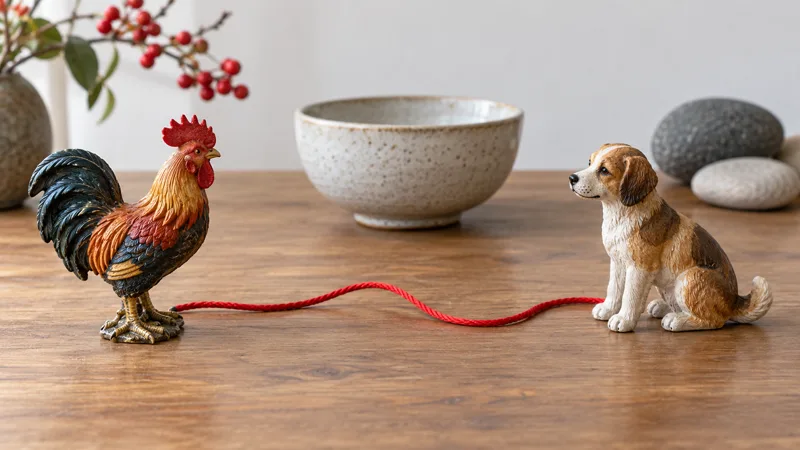
The lunar year that began in 1993 did not end when the Gregorian calendar reached January 1, 1994. It continued until the day before the 1994 Lunar New Year. For that reason, January 1 through February 9 remains part of the previous Water Rooster year under this method.
This is not an exception added to the zodiac cycle. It is simply the result of comparing two calendars with different year boundaries. Lunar New Year moves within January or February, so the cutoff must be checked for each specific year rather than copied from a nearby example.
When a family record, school project, or calculator result covers a date close to February 10, write the method beside the answer. “Lunar New Year method” makes the classification reproducible and prevents a later reader from assuming that January 1 was used automatically.
What the Wood Dog label describes
Chinese year names combine an earthly branch with a heavenly stem. In this case, the Dog branch is paired with the Wood element in the Jia-xu designation. The label identifies a place in the traditional sixty-year cycle; it is more precise than naming the animal alone.
Popular cultural writing often connects the Dog with loyalty, alertness, fairness, or protectiveness, while Wood may be described through growth, flexibility, or cooperative development. These are symbolic associations used in stories, celebrations, and traditional interpretation. They are not measured personality traits.
A birth year cannot establish temperament, compatibility, career ability, health, or future events. Two people born in the same lunar year still have different families, experiences, choices, and circumstances. The sound use of the label is calendar identification plus cultural context, not a verdict about a person.
Lunar New Year and Li Chun answer different boundary questions
Some Chinese astrology and BaZi systems use Li Chun, the Beginning of Spring, as a technical boundary. Li Chun fell earlier in February than Lunar New Year in 1994, so a specialist chart may classify a few near-boundary dates differently from this general year guide.
That disagreement does not make either calculation meaningless, but the convention must be named. This page uses Lunar New Year because it provides a clear public calendar boundary for an ordinary zodiac-year lookup. A technical reading should state whether it uses Li Chun and may also require birth time and location.
If two tools disagree, do not average their answers. Check their boundary rule, confirm the birth date, and keep the result tied to the selected method.
A reliable way to record the result
Start with the full Gregorian date. Compare it with February 10, 1994, then write down the animal, element, and method in one line. For example, a date after the cutoff can be recorded as “Wood Dog, Lunar New Year method.” A date before it can be recorded as “Water Rooster, Lunar New Year method.”
Keep source evidence with the note when accuracy matters. An official Gregorian-lunar conversion table is stronger evidence for the date boundary than an unlabeled social-media graphic. Secondary cultural overviews can help explain the cycle, but they should not replace the calendar source.
Finally, separate the verified calendar result from optional symbolism. The date and cycle pairing can be checked. Personality claims cannot be proven from a birth year, so they should remain clearly qualified.

1994 zodiac lookup checklist
- Use the complete birth date, not only the Gregorian year.
- Apply February 10 as the Lunar New Year start for the 1994 lookup.
- Classify January 1 through February 9 under the previous Water Rooster year.
- Record Wood Dog together with the boundary method.
- Treat personality language as cultural symbolism, not scientific evidence.
Questions about the 1994 Wood Dog year
What Chinese zodiac animal is 1994?
Under the Lunar New Year method, February 10, 1994 began the Year of the Dog.
What element is the 1994 Chinese zodiac?
The traditional pairing is Wood Dog, also written as the Jia-xu year in the sexagenary cycle.
Is January 1994 part of the Dog year?
Not under the Lunar New Year method. January 1 through February 9, 1994 still belongs to the previous Water Rooster year.
When did the 1994 Wood Dog year end?
The next lunar year began on January 31, 1995, so January 30, 1995 was the last day of the 1994 Wood Dog lunar year.
Does being born in a Wood Dog year determine personality?
No. Wood Dog descriptions are cultural symbolism, not a scientific personality test or a guaranteed forecast.