 Chinese Zodiac Guide
2014 Year of the Chinese Zodiac: Wood Horse Dates and Meaning
Quick Answer: The 2014 Chinese zodiac year is the Wood Horse, but a January birthday needs a closer look. Using Lunar New Year as the boundary, the Horse year runs from January 31, 2014, through February 18, 2015. Someone born earlier in January 2014 belongs to the preceding Snake year under this method.
The January 31 boundary: which year includes your birthday?
The quickest way to answer a year-sign question is to compare the complete birth date with the year boundary. A Gregorian year starts on January 1; the lunar new year does not. That difference matters for a baby born on January 30 and one born the next day, even though both birth certificates say 2014.
Quick Reference: birth dates under the Lunar New Year method
| Birth date | Year sign under the Lunar New Year method |
|---|---|
| January 1-30, 2014 | Water Snake, continuing from the previous lunar year |
| January 31, 2014-February 18, 2015 | Wood Horse |
| February 19-December 31, 2015 | Wood Goat, within the following lunar year |
The Hong Kong Observatory's 2014 conversion table places the first lunar month on January 31 and identifies the year as Jia-wu, Horse. Its 2015 table places the following Lunar New Year on February 19. These are calendar references: they establish dates and year names, not predictions about an individual.
For example, February 1, 2014, falls inside the Horse interval, while January 20, 2014, does not. February 1, 2015, is still in the same Horse year. Checking just the last two digits of a birth year would miss both January and February exceptions.

Why the full name is Wood Horse
- Heavenly stem
- Jia, 甲
- Earthly branch
- Wu, 午
- Animal
- Horse
- Element
- Wood
Quick Facts: Jia stem; Wu branch; Horse animal; Wood element.
Horse is the animal part of the label. The fuller calendar name, Jia-wu, combines a heavenly stem with an earthly branch. The Observatory's stem-branch table shows this pair in the repeating sixty-part cycle. The branch spelling Wu here should not be confused with a different heavenly stem also written wu in English; Chinese characters distinguish the two.
The element comes from Jia, written 甲. Table 5 on printed page 14 of this scholarly appendix hosted by Harvard's Asia Center groups Jia and Yi under Wood. That is the direct reason for the label Wood Horse. The correspondence supplies a classification within the traditional system; it does not establish a person's temperament.
Quick facts: the animal is Horse; the stem is Jia, 甲; the branch is Wu, 午; the element is Wood. Keep the element and animal together when comparing a full year label, rather than assuming every Horse year has the same element.
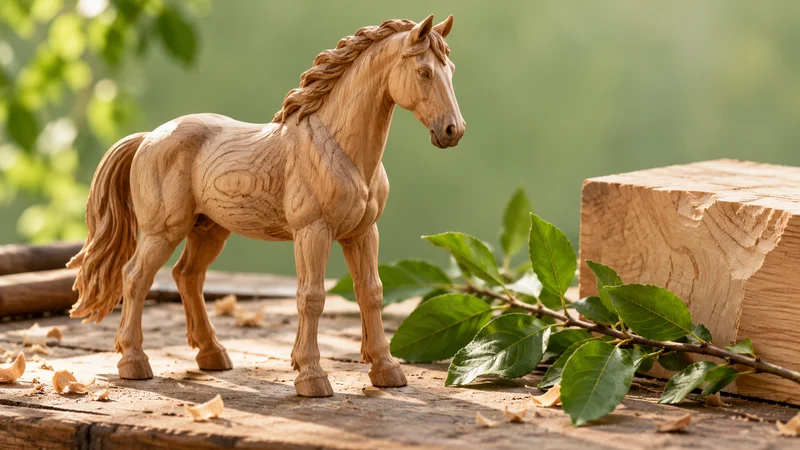
A Horse returns sooner than a Wood Horse
The animal sequence repeats every twelve years. The full stem-branch pairing takes sixty years to return. Consequently, sharing an animal does not necessarily mean sharing the element. This distinction is useful when comparing relatives whose births are twelve or twenty-four years apart.
Starting from the Jia-wu label in 2014, one full sixty-year cycle earlier gives 1954, and one later gives 2074. Those are cycle comparisons, not a claim that January 1 starts each associated lunar year. A birth near a year's beginning still requires its own calendar boundary check. Our zodiac years overview provides a starting point for another birth year.
If you are making a family birthday note, record the ordinary birth date alongside the sign and the method. An entry such as "February 1, 2015; Wood Horse; Lunar New Year boundary" is clearer than "2015 equals Horse." It preserves enough context for another reader to understand why a date in 2015 has been placed in a year commonly called 2014.
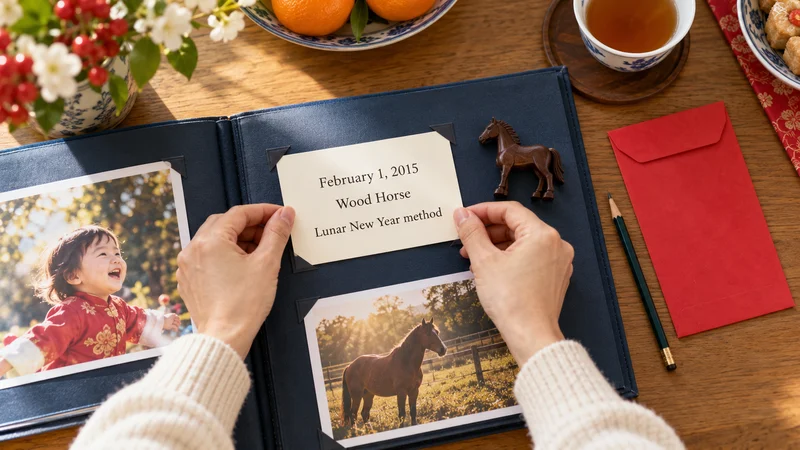
What the label can and cannot tell you
Wood Horse is a cultural calendar identity, not a personality test. You can use it to understand a year-themed gift, a family conversation, or an animal motif without deciding that everyone born in that interval must behave alike. A carved horse in an illustration is an example of the motif, not evidence about a historical person's character or prospects.
This page uses the Lunar New Year method throughout. Do not combine its date table with a calculator that applies a different year boundary without first checking that calculator's stated method. If two results disagree, comparing the boundary convention is more useful than choosing whichever description sounds more flattering.
No relationship, health, career, or financial decision follows from this calendar label. A useful personal description comes from the person and the circumstances. The year sign can remain part of a cultural conversation without becoming a fixed verdict.
Questions about the 2014 year sign
Is every person born in 2014 a Horse?
No. Under the Lunar New Year method, January 1-30 remains in the preceding Snake year. The Horse interval begins January 31.
Does the Wood Horse year end on December 31, 2014?
No. It continues through February 18, 2015. The next lunar year starts February 19, 2015.
Why does Jia-wu mean Wood Horse rather than Fire Horse?
The Jia stem corresponds to Wood; the Wu branch corresponds to Horse. The element is not chosen from the animal's appearance or from a personality description.
Can I use the result as a personality prediction?
The label belongs to a traditional calendar and cultural system. It does not establish an individual's personality or guarantee future events.