 Chinese Zodiac Guide
Chinese Lunar Calendar: Months, Leap Months, and Date Tables
A lunar date needs more than a month and day. To read it correctly, you also need the year, the calendar convention, and sometimes a leap-month label. Those details explain why a date can seem to move on a Gregorian calendar without moving within its own calendar.
Quick Answer: The Chinese lunar calendar is more precisely a lunisolar calendar: its months follow the Moon while its year is kept aligned with the seasons. Months have 29 or 30 days, and some years add a leap month. For an actual date, use a year-specific Gregorian-lunar conversion table rather than subtracting a fixed number of days.
The moving parts of a lunisolar date
- Calendar type
- Lunisolar; often called the Chinese lunar calendar or Nongli.
- Lunar month length
- 29 or 30 whole days, not a fixed 30-day block.
- Month count
- 12 in an ordinary year; 13 when a leap month is included.
- Leap-month identity
- An extra month repeats the preceding month number and keeps a leap designation.
- Conversion date range
- Hong Kong Observatory publishes year tables for 1901-2100.
These are calendar facts, not evidence for personality, compatibility, or predictions.
Why 'lunar' is familiar but 'lunisolar' is more precise
The Hong Kong Observatory's calendar introduction describes Nongli as an integrated lunar-solar calendar. The Moon supplies the month rhythm; the Sun supplies the seasonal framework. The everyday label 'lunar calendar' is useful, but it leaves out that second part.
Think of someone comparing a festival entry in two calendars. The Gregorian month and day are one coordinate system; the traditional month and day are another. A change in the Gregorian date does not, by itself, mean that the traditional date has been changed. Before comparing entries, identify which system each number belongs to.
This guide concerns the calendar's structure, not a list of auspicious dates. A calendar can establish which date a record denotes. It cannot establish that the date will produce a particular personal outcome. Keeping those questions separate also makes a practical lookup much easier to check.

A month is not a fixed block of thirty days
The Observatory explains that months begin with a new moon. A new moon is an astronomical alignment, not the first visible crescent. A photograph of a crescent therefore cannot establish the exact first day of a traditional month.
Calendar dates are whole days, even though the lunar cycle is not a whole number of days. This is why a month can end on day 29 or day 30. Do not fill a missing thirtieth day into a record simply because the previous month had one, and do not assume that the lengths alternate in an easy pattern.
For a practical check, read the next month-start entry in the published table. That tells you where the current month ends. Counting forward from an assumed thirty-day template can shift every later entry, so it is especially unsuitable for copying family dates or planning a calendar display.
A leap month repeats a number, not an ordinary date
L. E. Doggett's calendar chapter hosted by NASA distinguishes ordinary twelve-month years from thirteen-month intercalary years. The inserted month takes the preceding month's number with an intercalary designation. It is not a Gregorian February 29 and should not be recorded as one.
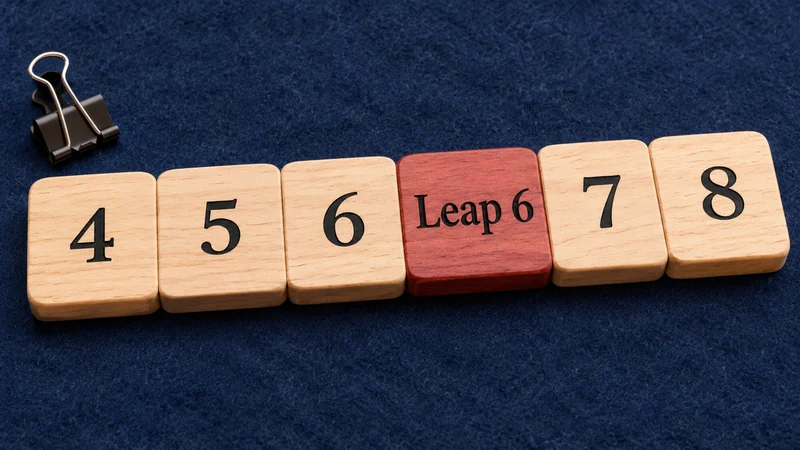
For illustration, 'month 6, day 10' and 'leap month 6, day 10' are different entries. The example describes the labels, not a conversion for a particular year. Omitting 'leap' would remove information needed to identify the date, even though the remaining digits look complete.
Do not add the extra month yourself after every third year. The published calendar rules depend on the relationship between lunar months and the solar framework, not a fixed three-year appointment. If a form has only a numbered month field, add a separate ordinary/leap field rather than forcing both kinds of date into the same value.
Read the Gregorian and lunar coordinates together
The Hong Kong Observatory conversion index offers one PDF for each year from 1901 through 2100. Open the year you actually need. In its 2025 table, Gregorian dates and corresponding lunar dates appear together; the legend explains how month starts are represented.
Start with a known Gregorian date, find its month row and day column, then read the corresponding lunar entry. If the cell gives a day number rather than a month-start label, trace back to the most recent month start. Preserve a leap designation wherever the table supplies one. Do not read the Gregorian column number as the lunar day.
When working in the opposite direction, match the lunar year, month number, leap status, and day before copying the Gregorian result. A screenshot cropped to just one row may hide the month-start label or the year heading. Keep the full table or its source URL with your note so that another person can repeat the lookup.
For a birthday-specific task, the birthday lookup guide separates lunar-date conversion from animal-year classification. They use related calendar information but return different kinds of answer. A zodiac animal is not a substitute for the complete converted date.
Solar terms and zodiac labels do not replace the date
Doggett's chapter explains that the solar year is divided into 24 terms and that winter solstice belongs to month 11 in the calendar rules it describes. A solar-term entry is not an extra lunar day. Nor does the presence of a seasonal label turn the lunar month into a Gregorian month.
Similarly, an animal-year label identifies a year category, not a particular day. When a person asks for a sign, the zodiac calculator is the relevant site tool; it should not be represented as a full lunar-date converter. Check the complete birth date and the method stated by the tool rather than assuming January 1 is the boundary.
For a family document, keep the original wording beside the converted result. If its calendar system or leap status is unknown, record that uncertainty instead of choosing the most convenient match. A precise-looking date copied from an incomplete entry is still uncertain.

Quick Reference: preserve these fields when converting
| Field | What to retain | Mistake to avoid |
|---|---|---|
| Input date | Complete date and its stated calendar | Copying numbers without naming the system |
| Traditional month | Number plus ordinary/leap status | Dropping a leap-month label |
| Output | Complete converted date | Saving only the zodiac animal |
| Evidence | Year table, legend and source link | Keeping a cropped row without the year |
For an important record, keep the original date and the conversion side by side. This is a documentation suggestion, not a new calendar rule.
Questions about month labels and conversion
Is the Chinese calendar purely lunar?
No. It combines lunar months with a solar seasonal framework, so lunisolar is the more precise description.
Is a leap lunar month the same as February 29?
No. A leap lunar month is an additional month with a repeated month number and a leap designation; February 29 is an added Gregorian day.
Can I subtract eleven days to convert a date?
No. A fixed subtraction does not account for changing month lengths and leap-month placement. Use the table for the year concerned.
Does a month always have a thirtieth day?
No. A lunar month has either 29 or 30 days. Check its end in the year-specific calendar instead of assuming day 30 exists.
What if a record omits whether a month is a leap month?
Preserve that uncertainty and consult the original record or another dated reference. The month number alone may not identify a unique date.
Calendar references
- Hong Kong Observatory: the Chinese Agricultural Calendar
- Hong Kong Observatory: Gregorian-lunar tables, 1901-2100
- Hong Kong Observatory: 2025 conversion table and legend
- L. E. Doggett: Calendars, section 6, hosted by NASA
Calendar sources checked on November 3, 2026. Generated illustrations below are teaching scenes, not official conversion tables or astronomical measurements.