 Chinese Zodiac Guide
1955 Year of the Chinese Zodiac: Wood Goat Dates and Facts
A 1955 birth year usually points to the Goat, but a January birthday can change that answer. The useful starting point is the day the new lunar year began, not the animal printed beside a Gregorian year on a souvenir.
Quick Answer: The 1955 year of the Chinese zodiac is the Wood Goat under the Lunar New Year method, running from January 24, 1955 through February 11, 1956, inclusive. January 1-23, 1955 still belongs to the preceding Wood Horse year. The stem-branch name is Yi-wei, written 乙未.
The dates and name attached to 1955
- Animal year
- Goat, following the English label used in the Hong Kong Observatory table.
- Five-phase designation
- Wood: the heavenly stem Yi (乙) belongs to Wood.
- Stem-branch name
- Yi-wei (乙未).
- First included date
- January 24, 1955.
- Last included date
- February 11, 1956.
- Convention used here
- Lunar New Year boundary; Gregorian input dates.
Calendar labels are not personality measurements or predictions. All three generated illustrations are modern teaching scenes, not historical documents.
January 23 and January 24 give different answers
The Hong Kong Observatory's 1955 conversion table identifies the year as Yi-wei, the Goat year. In its January row, the first lunar month begins on January 24. This is the boundary used throughout this page.
Someone born on January 23, 1955 therefore falls before that change and is classified in the preceding Horse year. Someone born on January 24 is on the Goat side of the boundary. The difference is one calendar day, not a judgment about which animal better resembles the person.
For birthdays later in 1955, such as July 10 or December 31, this particular January exception no longer applies: both dates are inside the Wood Goat interval. For a January entry, write the full date before choosing a label. 'Born in 1955' alone is not enough to settle every case.
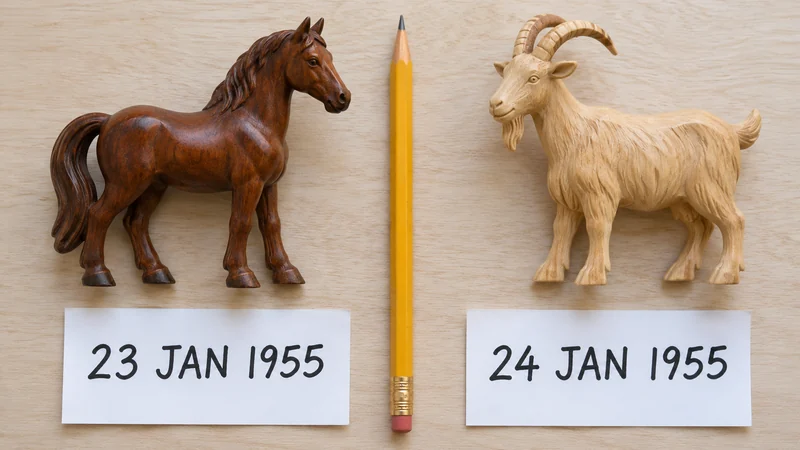
Why the name includes Wood as well as Goat
Yi-wei has two parts. Yi is a heavenly stem; wei is an earthly branch. The Observatory's stems-and-branches explanation sets out the paired cycle. The animal and the element are related labels in that framework, but they are not interchangeable names for one thing.
For the element correspondence, Table 5 on PDF page 14 of the Harvard Asia Center-hosted appendix on Shen Gua explicitly places jia (甲) and yi (乙) under Wood. Combining that correspondence with the Yi-wei year heading gives the familiar English expression 'Wood Goat'. The wooden material of the illustration is a visual aid, not the evidence for the designation.
This also explains why 'Goat year' does not automatically mean 'Wood Goat year'. An animal label by itself omits the heavenly stem. If comparing relatives born in different Goat years, compare their complete year designations rather than copying 1955's element to every Goat entry.
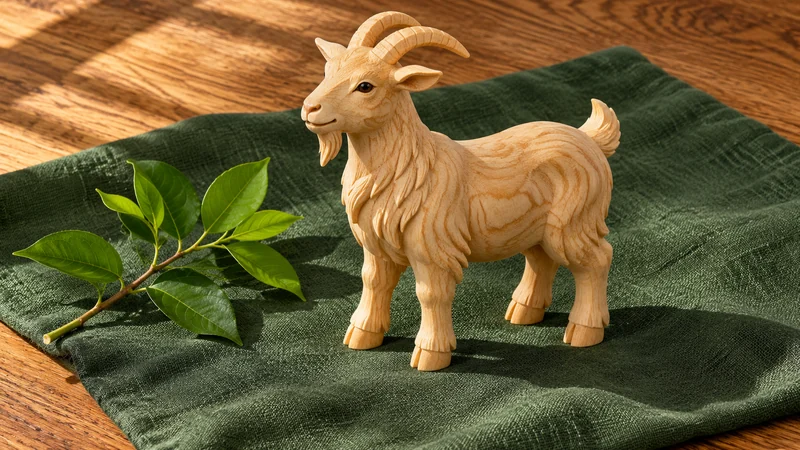
Early 1956 can still belong to the 1955 Goat year
The other end of the interval is just as important. The Observatory's 1956 table places the first day of the first lunar month on February 12, under the new Bing-shen Monkey year. Consequently, February 11, 1956 is still inside the preceding Yi-wei Goat year.
A birthday of February 1, 1956 is therefore a Wood Goat date under this convention, despite the Gregorian year number saying 1956. February 12 belongs to the next Monkey year. Neither example needs a personality description to determine the result: compare the complete date with the stated endpoints.
Notice that the 1956 table also lists Spring Commences on February 5. That solar-term entry is not the February 12 Lunar New Year entry. This page uses the latter and does not calculate an alternative solar-term-based birth chart. When another reading gives a different boundary, first ask which convention it is using.
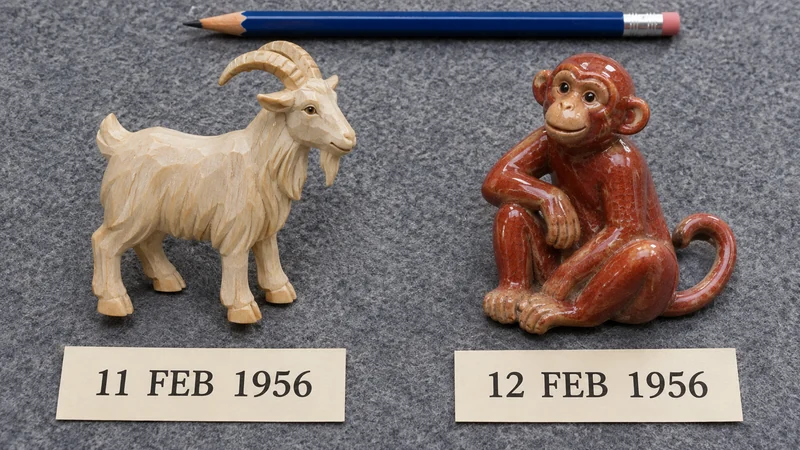
Read a birthday record before applying a year label
Check whether a recorded date is Gregorian or lunar before comparing it with the ranges below. A lunar month and day copied into a Gregorian date field will not become a valid conversion simply because all three fields contain numbers. The source table keeps both systems visible so the coordinates can be distinguished.
For example, 'January 23, 1955' on a Gregorian birth record is the Horse-side example above. An entry described as 'the first lunar month, day 23' is a different kind of input and must be converted before using this Gregorian boundary table. Do not silently treat the two descriptions as equivalent.
The site's lunar-calendar guide explains month labels and leap months. Once the input is a complete Gregorian date, the zodiac years chart is useful for comparing dated year entries. These are calendar aids; neither supplies evidence about the character or future of the person named in a record.
What a Wood Goat label does not tell you
The official conversion tables establish dates and year names. The five-phase table establishes a traditional correspondence. They do not establish that everyone in the interval shares a personality, has a particular relationship match or will experience the same events.
If using the label in a family celebration, a caption such as 'Yi-wei Wood Goat year, using the Lunar New Year boundary' makes the method clear. If using it for personal reflection, keep that cultural interpretation separate from the verified calendar answer. A birth-year category is not a test of temperament or a reason to make health, financial or relationship decisions.
The most useful finished note is short: the original birth date, its calendar system, the convention used and the resulting year label. That preserves how the answer was obtained without attaching an unsupported description to the person.
Quick Reference: birthdays across the two boundaries
| Gregorian date range | Year label under this method | Reason |
|---|---|---|
| January 1-23, 1955 | Wood Horse | Before the 1955 Lunar New Year. |
| January 24-December 31, 1955 | Wood Goat | After the January 24 boundary. |
| January 1-February 11, 1956 | Wood Goat | Before the next Lunar New Year. |
| February 12-December 31, 1956 | Fire Monkey | Inside the next year; this row stops at the end of 1956. |
All endpoints are inclusive. The last row covers only the stated portion of 1956, not every later date.
Questions about 1955 and January birthdays
What Chinese zodiac animal is 1955?
It is the Goat year for January 24, 1955 through February 11, 1956 under the Lunar New Year method. January 1-23, 1955 remains in the preceding Horse year.
Is 1955 a Wood Goat year?
Yes. The year's name is Yi-wei; Yi (乙) is associated with Wood in the traditional heavenly-stem correspondence.
What is the sign for January 23, 1955?
Wood Horse under the Lunar New Year convention used here. The Wood Goat interval starts the following day, January 24.
Does January 1956 count as Wood Goat?
Yes. January 1956 precedes the next Lunar New Year on February 12, so it remains in the Wood Goat interval.
Does the Wood Goat year end on December 31, 1955?
No. It continues through February 11, 1956. The Gregorian year boundary and the Lunar New Year boundary are different.
Sources for the dates and Wood designation
- Hong Kong Observatory: 1955 Yi-wei Goat conversion table
- Hong Kong Observatory: 1956 Bing-shen Monkey conversion table
- Hong Kong Observatory: heavenly stems and earthly branches
- Harvard Asia Center: Appendix 3, Table 5, PDF page 14 (stems and five phases)
Sources read on November 4, 2026. The calendar PDFs support the dated boundaries; the Harvard-hosted appendix supports the stem-to-Wood correspondence. These sources are not evidence for personality or compatibility predictions.